By YardHatch · Published · Updated
Draw nonoverlapping rectangles, triangles and circles, then subtract areas that receive no material. Keep the sketch with your dimensions so overlaps and missing sections can be checked.
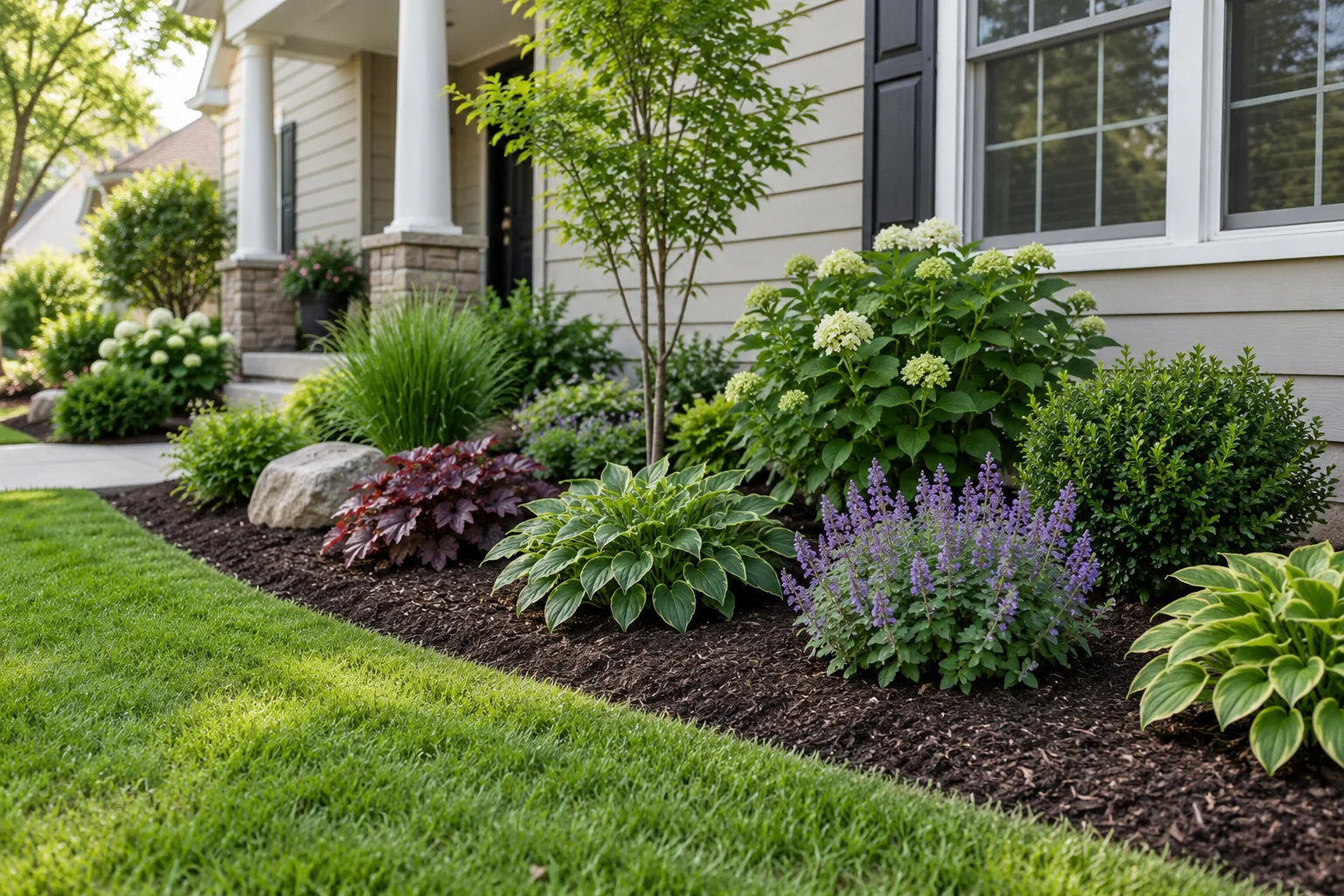
Sketch boundaries before taking measurements
Mark walls, paths, existing beds and permanent objects. Give each section a name. A curved edge can be approximated using several small shapes, but record that it is an approximation rather than pretending every boundary is straight.
Use the right dimension for each shape
A triangle needs a base and perpendicular height. A circle uses radius, which is half the diameter. Mixing radius and diameter makes the circle area four times too large. The table shows a simple composite example with an excluded rectangle.
| Section | Dimensions | Signed area |
|---|---|---|
| Main rectangle | 12 × 8 ft | 96 sq ft |
| Triangular end | 8 × 6 ÷ 2 | 24 sq ft |
| Circular island | Radius 2 ft | 12.566 sq ft |
| Excluded rectangle | 2 × 3 ft | −6 sq ft |
Do not count an overlap twice
If two rectangles overlap, trim one shape to the shared boundary or subtract the overlap once. Exclusions must be inside the measured area. The multi-zone planner checks that exclusions do not exceed the total, but you must still verify their position on the sketch.
Carry the result into the next step
The example totals 126.566 sq ft. At a modeled 3 inch depth, it requires 1.172 cubic yards. Save the area for another tool, then choose depth, product and package size there. Do not reuse a lawn area for a bed simply because the number is already saved.
Make it your own estimate
These are modeled calculations. Actual products, installation conditions and supplier requirements control your order.
Open the related toolContinue with the project or reference · Compare supplier quotes
Sources and method
University of Maryland Extension: Determining the area/size of a practice provides the relevant background guidance. Worked tables are YardHatch arithmetic using the visible assumptions, not source price data or field observations.